

True School
(This Space Available For Purchase)

I’ve been thinking a lot lately about what it means to think beyond yourself.
That sounds noble, maybe even a little grand, but I don’t mean it in some polished, inspirational-poster kind of way. I mean it more urgently than that. I mean it as a practical discipline. A survival skill. A moral obligation.
Think beyond yourself.
Because if you don’t, someone else will think for you.
And worse, someone else will fill the space you left open.
They will decide what matters.
They will decide what is worth protecting.
They will decide what is worth teaching.
They will decide what young people deserve.
They will decide what art is for.
They will decide what technology is allowed to do to us in the name of convenience.
THIS is about how when you are wondering if you should enter a space that might be tricky, might be something that could go either way, say AI, for example. If you are doing that, and you are worried that it might not be safe, that’s the reason you are needed in that space. You need to be there, taking up space because you have questions and you aren’t sure.
And once that space is filled, once intention has been replaced by momentum, or by profit, or by branding, or by some false version of inevitability, it becomes very hard to get it back if you aren’t already in it.
That’s what I’ve been thinking about.
Intentions.
What do we intend when we build something? What do we intend when we teach?
What do we intend when we put a tool into the world? What do we intend when we say we want to make something “accessible” or “affordable” or “for everyone”?
Those words sound good. They are good, often. But they are not innocent. They carry consequences. They shape systems. And if we are not careful, they become excuses for surrender.
You hear it all the time now, especially when people talk about technology, media, education, and the future.
“We need ads to make that affordable to all of the world.” This is stated as an intention as to why something that used to be uninterrupted by ads, now has ads. But do we need that to make something available for everyone? Do we?
Maybe sometimes that’s true. Maybe there are models where that logic makes sense. But I’ve lived long enough to know that whenever someone tells you there is only one way to make a thing available to people, you should stop and examine who benefits most from that “only one way.”
Affordable for whom? Available under whose terms? Accessible at what cost? And what exactly are we teaching people to tolerate in exchange for entry?
Because there is always a trade.
Always.
The trade might be your attention. Your privacy. Your authorship. Your concentration. Your standards. Your sense of what learning is. Your belief that difficulty has value.
Your trust that the person on the other side of the desk, or the screen, or the institution is acting in your best interest. That last one matters to me more and more.
I keep coming back to ethics. Not ethics as a buzzword. Ethics as intention made visible. Ethics as the decision to build a doorway instead of a trap. It matters who gets things into a space. It matters who opens the gate.
It matters because if you are not intentional about putting something decent, thoughtful, humane, and ethical into the world, somebody else will absolutely rush in with something cheaper, louder, faster, more extractive, and somehow still call it progress.
That goes for schools.
That goes for studios.
That goes for platforms.
That goes for every room where people are privileged by their position to decide what is normal now.
I was in class last night and heard from one of those people. He said this.
“If we have technology that can write an essay, then what are we doing giving the same take-home essay test and pretending nothing has changed?”
If a machine can generate a passable paper in a few seconds, then maybe the assignment was never actually measuring what we thought it was measuring. Or maybe it was, once, but not anymore. Either way, pretending the world hasn’t changed is not rigor. It’s nostalgia carrying a backpack with five books in it, one for each class.
After class last night, when I left the room, it was buzzing. Small groups had gathered to talk about their projects they were designing for their final. I called a friend on the way home who is taking this class, from AZ and zooming into it with about 30 other students. She said that the same thing had happened there. People hung around to share what they were thinking of doing for their final project and so the buzz was there, too.
Make something. Share it. Revise it. Collaborate. Experiment. Lather. Rinse. Repeat.
Not doing an essay because now there’s a tool that will write an essay for you, doesn’t mean the end of writing. NO DAMN WAY. Because what I just described IS WRITING.
Make something. Share it. Revise it. Collaborate. Experiment. Lather. Rinse. Repeat. That’s being in a writing room on a TV show.
It’s not that writing no longer matters. Quite the opposite. Writing matters so much that we should defend the real thing. We should defend thought. We should defend struggle. We should defend the messy, human process of trying to say something clearly before you fully know what you mean.
Guess what else this can resemble and should resemble?
Education. Education isn’t memorization anymore. Or regurgitation. It’s not knowing the polished answer. Not the suspiciously competent paragraph that arrives without fingerprints and smudge marks, and too many “So”s and “Then”s. Yeah, I know I have too many of those in my writing. But to some degree (I do try and edit those), the fingerprints and smudge marks are the point.
One of my co-instructors threw out this phrase last night and I scrambled to write it down as soon as he said it. “True School.” His intention with that phrase was to call out that “Old School,” could be given more reverence and more status if we called it “True School.” I loved hearing it. I thought about it when I was walking to my truck. I thought about it differently. To me, “True School,” is in the fingerprints, the smudges, and also knowing how to update your software. It’s not just knowing a fact. It’s not just access to tools. It’s learning when and why to use them. Knowing what you wouldn’t give up to use those tools. What your lines and boundaries are. It’s not just expression. It’s intention.
Sometimes we confuse scale with value. We assume that if something reaches everyone, it must be good. Or if something is frictionless, it must be democratic. Or if something is fast, it must be modern. But speed is not wisdom. Know who already knew that before even the calculator was invented? These guys.
That’s why intention matters so much. Because in every vacuum, something enters. If you don’t bring ethics into technology, business will fill that space. If you don’t bring imagination into education, standardization will fill that space. If you don’t bring humanity into media, advertising will fill that space.
If you don’t think beyond yourself, somebody else will gladly do the thinking for you, and they may not love people the way you do. I could stop there. Toss my pen down (nope it’s a laptop, don’t do that). Say that’s the whole enchilada and send it to the printer (nope also).
But then today, I had one of those little moments that felt bigger than it should have. I was at my local comic book store buying my weekly books, doing the thing I love.
PAUSE FOR AD FOR HENCHMAN EVEN THOUGH I JUST QUESTIONED THE NEED TO PAUSE FOR ADS.
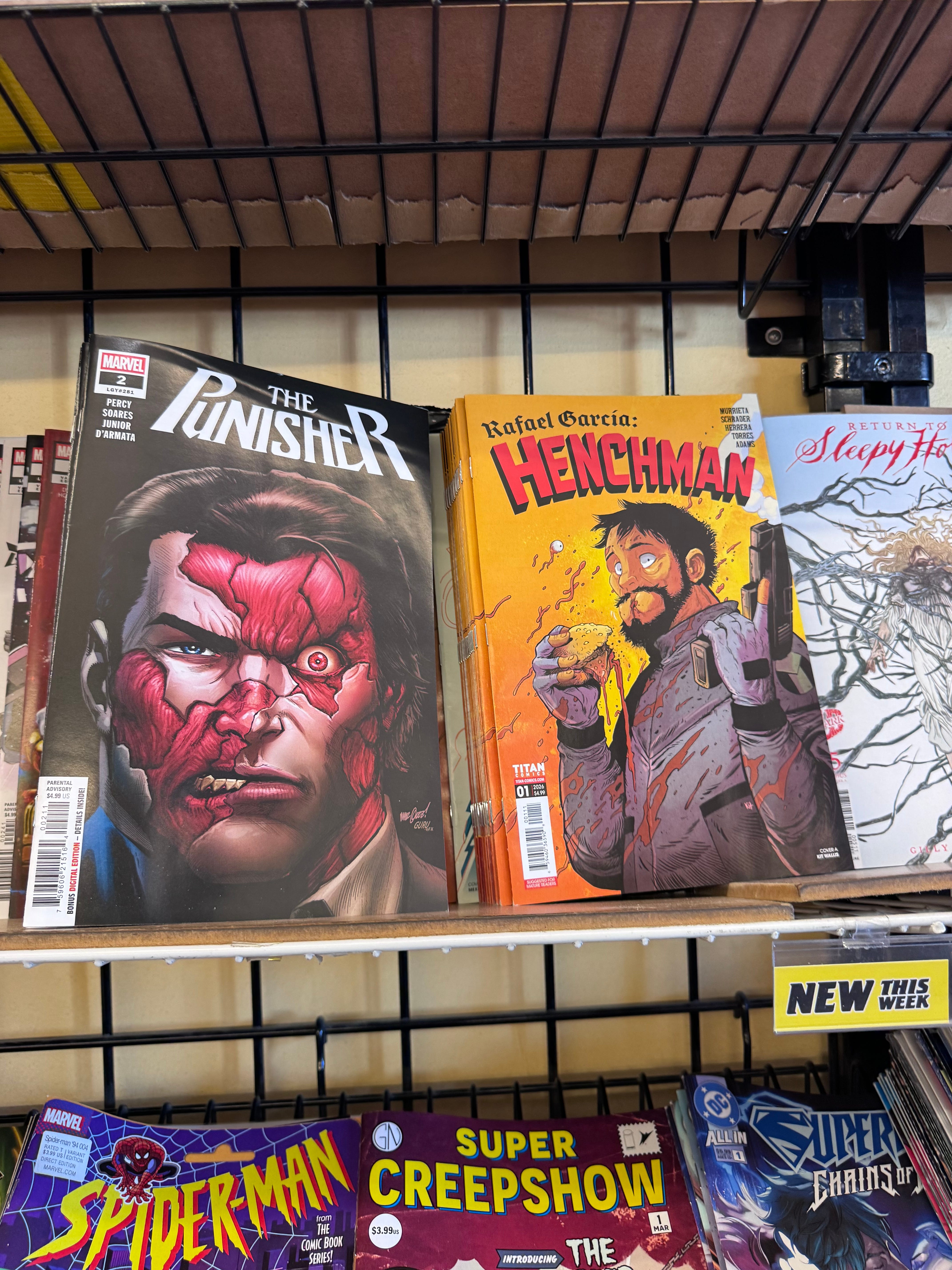
And there was a nine year old boy with glasses and his mom in the store. I had never seen them before. He was asking where he could get anything that would be about Miles Morales, the one true Spider-Man, as we all know. I felt like I was looking at nine year old me, coming back from my twice a week allergy shots, begging my mom to go get comics. I might have even pretended that those shots hurt worse then they did so she’d take me to the drugstore which had one spinning rack of comics. So I walked over to where autographed copies of my comic, “Rafael Garcia: Henchman,” was —
PAUSE FOR SECOND AD BECAUSE ONCE YOU GET USED TO THE ADS ON A PLATFORM THERE’S NO STOPPING THEM.
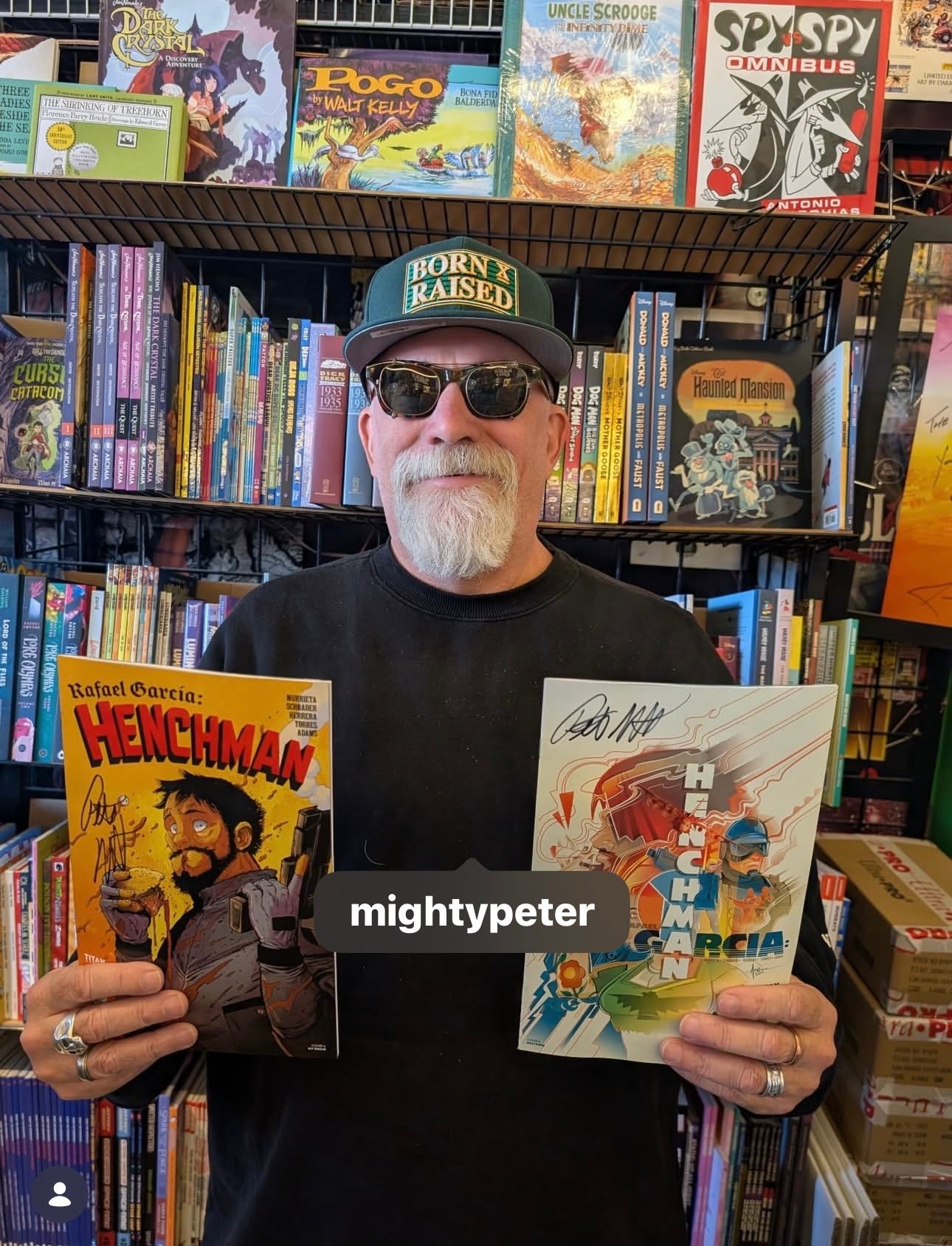
— and I gave a comic book to a nine-year-old boy with glasses. I gave young me a comic book that I wrote and autographed. It’s not Bad Bunny giving young Bad Bunny a Grammy that he will win one day. That was watched by billions. This was seen by just me, the kid and his mom. No giant fireworks. No swelling soundtrack. Just a kid, in a comic book store, receiving a comic book. And it made me feel right with the world.
Because I remember what it means to be that age and receive an invitation. A portal. A vote of confidence. A little rectangle of paper that says: here, this world is for you too. A comic book is never just a comic book to the right kid. It’s permission. It’s possibility.
And I think that’s why the moment hit me so hard. Because all day I’d been thinking about systems and ethics and technology and education and intention, and then suddenly there it was, stripped down to its most human scale: put the right thing into the hands of a child.
Here. This is something I dreamed up. And then people made it. It’s my imagination and I’m handing it to you. My voice and it made a world. Take it. This mattered to me, maybe it will matter to you.
Think beyond yourself. Keep putting good stuff in the right hands. And maybe somebody will do that to you.
THE MOST IMPORTANT CHCANO IN HOLLYWOOD THAT YOU DON’T KNOW ABOUT
PS: My signature scent creation has to wait one more week, sadly. Deadlines and stuff, know what I mean?